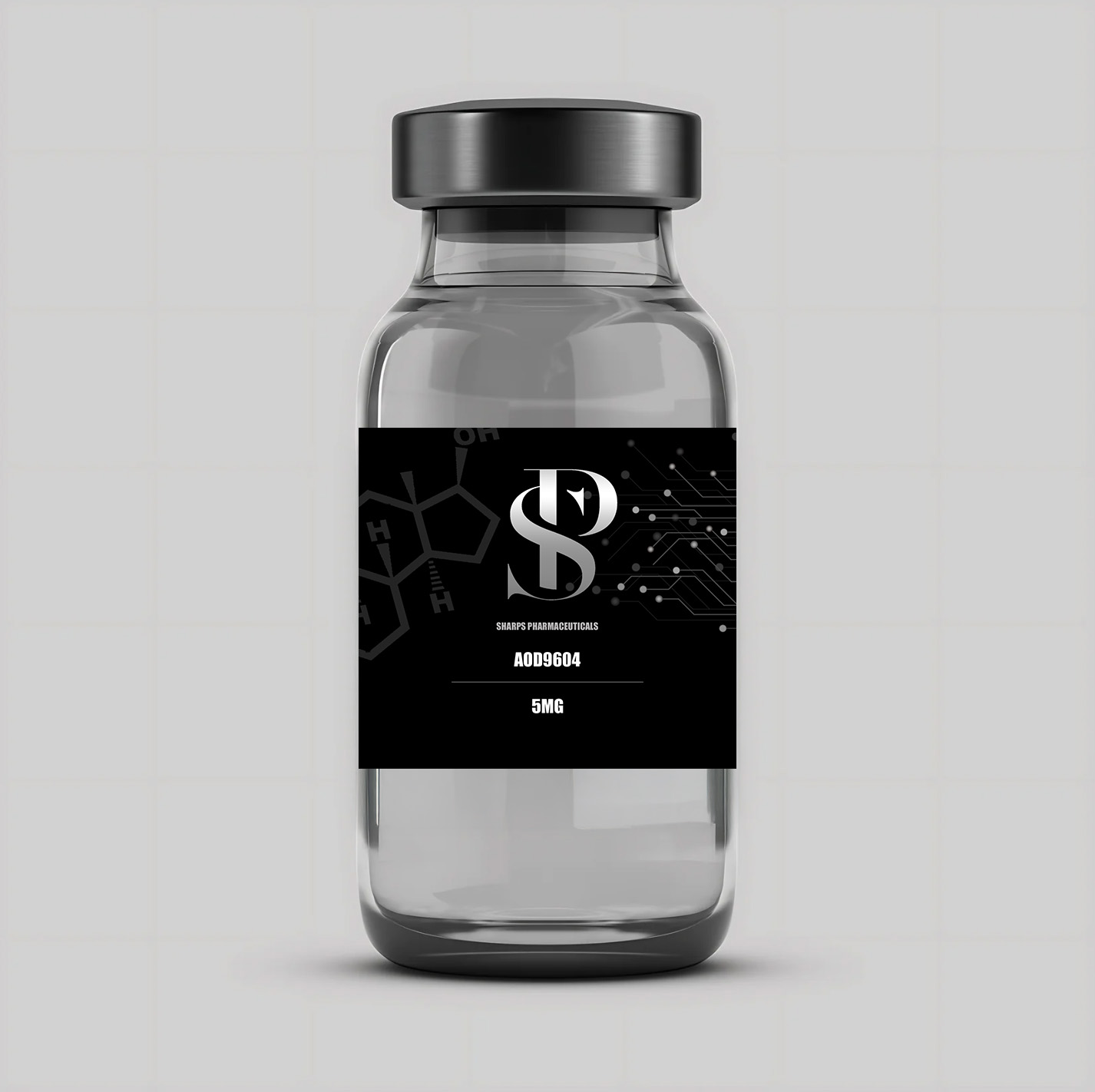
AOD-9604 Research Overview: The Growth Hormone C-Terminal Fragment
Written from the cited peer-reviewed literature; every product lot is third-party tested.
For research purposes only. This content is intended for educational and informational purposes. Products mentioned are sold strictly for laboratory research use. Not for human consumption. Not for human use. Read more
AOD-9604 is a synthetic peptide corresponding to residues 177–191 of human growth hormone, with an extra tyrosine added at the N-terminus. It was developed to study the C-terminal region of the growth hormone molecule in isolation.
This overview covers its structure, a common naming confusion, its origins and the main preclinical research.
Structure and the 177–191 versus 176–191 naming
Human growth hormone is a 191-amino-acid protein. AOD-9604 contains the last 15 amino acids of that chain (residues 177–191) plus one added tyrosine at the start, for 16 amino acids in total.
Because the added tyrosine sits where residue 176 would be, AOD-9604 is sometimes described as "hGH fragment 176–191". Both descriptions refer to the same 16-amino-acid peptide. When reading the literature or comparing suppliers, check the sequence and molecular mass on the certificate of analysis instead of relying on the name.
Origins
AOD-9604 was developed at Monash University in Australia in the 1990s, as part of research into whether the C-terminal region of growth hormone carried activity of its own, separate from the rest of the molecule.
Preclinical research
Research on AOD-9604 has focused on lipid metabolism in laboratory models.
- Heffernan and colleagues (Endocrinology, 2001) compared AOD-9604 with full-length growth hormone in mouse models, including models lacking the β3-adrenergic receptor, examining lipolysis and lipogenesis in adipose tissue.
- Studies have examined AOD-9604 in isolated adipose tissue and fat-cell preparations.
- The literature reports that AOD-9604 does not act like full-length growth hormone at the growth hormone receptor, which is why it is used to study the C-terminal region separately.
Most published research on AOD-9604 is preclinical, and results in one model do not establish activity in another.
Handling in the laboratory
AOD-9604 is supplied as a lyophilized powder and is generally reconstituted with bacteriostatic water before use. Sealed vials are stored at -20°C, protected from light and moisture.
Testing and documentation
Every lot we sell is tested by Freedom Diagnostics, an independent laboratory, using HPLC for purity and mass spectrometry for identity. Certificates are published in our COA library, and each can be verified directly with the lab using the search code printed on it. Our guide explains how to verify a COA.
References
- Heffernan M, Summers RJ, Thorburn A, et al.. The effects of human GH and its lipolytic fragment (AOD9604) on lipid metabolism following chronic treatment in obese mice and beta(3)-AR knock-out mice. Endocrinology. 2001. pubmed.ncbi.nlm.nih.gov/11713213/
Every lot is third-party tested. View the certificate for AOD-9604 →
Related reading
For research purposes only. All products from Canada Research Labs are supplied strictly as reference materials for in-vitro laboratory research by qualified professionals. They are not drugs, natural health products or cosmetics, and have not been authorized by Health Canada for any human or veterinary use.
