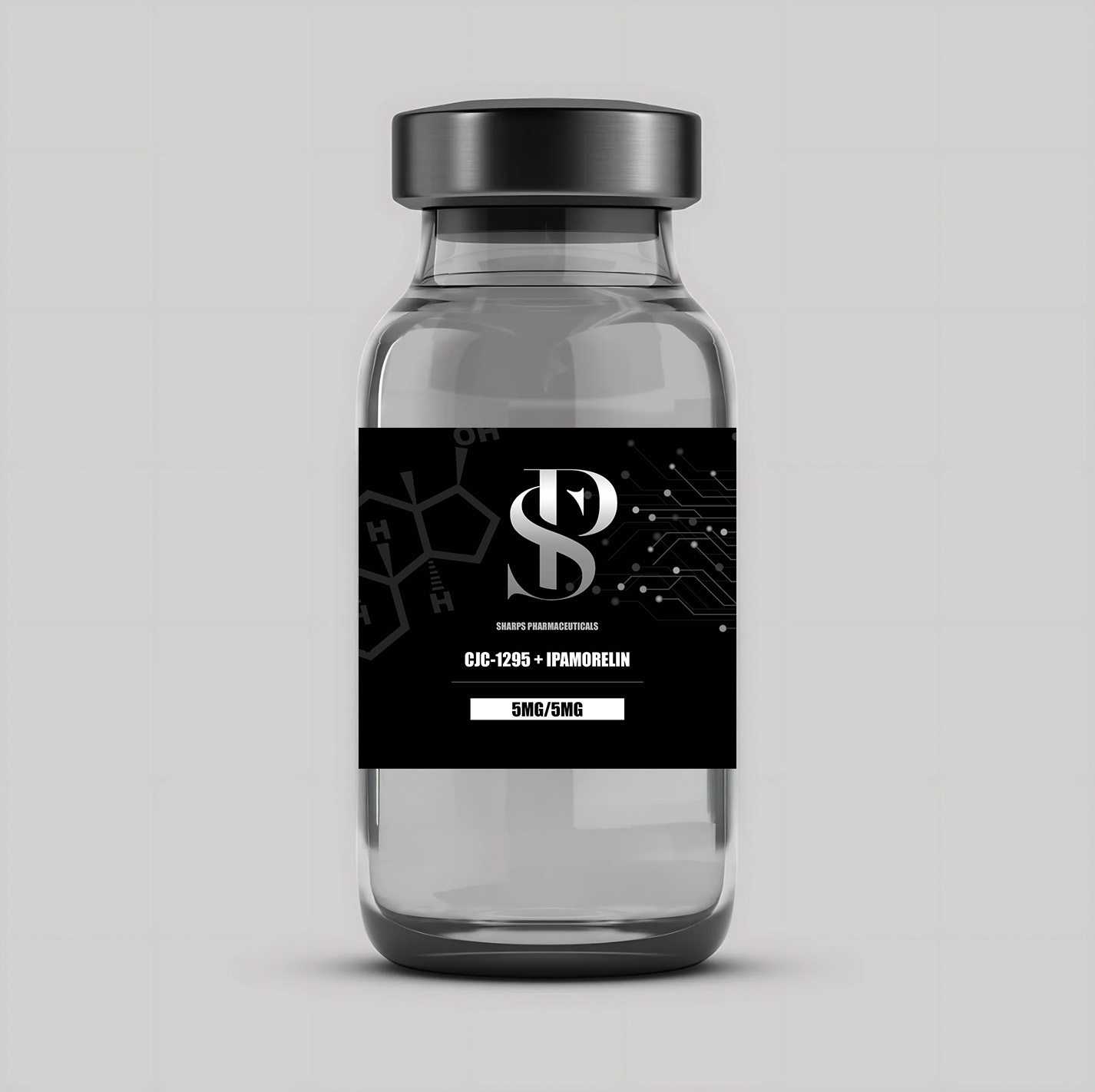
CJC-1295 and Ipamorelin Research Overview: Two Receptor Pathways
Written from the cited peer-reviewed literature; every product lot is third-party tested.
For research purposes only. This content is intended for educational and informational purposes. Products mentioned are sold strictly for laboratory research use. Not for human consumption. Not for human use. Read more
CJC-1295 and Ipamorelin are two synthetic peptides that act on different receptors involved in growth hormone release. CJC-1295 is an analog of growth hormone-releasing hormone (GHRH), and Ipamorelin is an agonist of the ghrelin receptor (GHS-R1a).
They are often studied together, and sold together as a blend, precisely because they work through separate pathways. This overview explains both pathways, the two very different molecules sold as "CJC-1295", and what researchers should check before comparing results.
Two pathways to growth hormone release
Growth hormone release from the pituitary is controlled by several signals. Two of the best studied are:
- The GHRH receptor, activated by growth hormone-releasing hormone from the hypothalamus
- The growth hormone secretagogue receptor (GHS-R1a), activated by ghrelin
The ghrelin receptor was identified in 1996 by Howard and colleagues (Science), and its natural ligand, ghrelin, was discovered in 1999 by Kojima and colleagues (Nature). Because the two receptors are distinct, compounds acting on each can be used to study the pathways separately or together.
CJC-1295: with DAC and without DAC
The name CJC-1295 is used for two quite different molecules, and this causes frequent confusion.
- Without DAC (also called Mod GRF 1-29 or tetrasubstituted GRF 1-29): the first 29 amino acids of GHRH, with four amino-acid substitutions (at positions 2, 8, 15 and 27) that make it more resistant to enzymatic breakdown.
- With DAC: the same modified sequence plus a lysine linked to a "drug affinity complex", a reactive group that binds albumin and greatly extends how long the peptide persists.
The two have different molecular weights and behave very differently in experiments. Check the certificate of analysis to confirm which one you have before comparing results with published work.
The CJC-1295 in our CJC-1295 + Ipamorelin blend is the version without DAC.
Ipamorelin
Ipamorelin is a synthetic pentapeptide (Aib-His-D-2Nal-D-Phe-Lys-NH2). Raun and colleagues described it in 1998 (European Journal of Endocrinology) as the first selective growth hormone secretagogue. In the animal models they reported, it acted on the ghrelin receptor with little effect on other pituitary hormones such as ACTH and cortisol, unlike several earlier secretagogues.
That selectivity is why Ipamorelin is widely used as a reference agonist for the ghrelin receptor. Our Ipamorelin research overview covers it in more detail.
Why study them together
Because CJC-1295 acts at the GHRH receptor and Ipamorelin at GHS-R1a, using both allows researchers to examine how the two pathways interact. Most published research examines each compound separately, and studies of the specific combination are limited and mostly preclinical.
Handling in the laboratory
Both peptides are supplied as a co-lyophilized powder and are generally reconstituted with bacteriostatic water before use. Sealed vials are stored at -20°C, protected from light and moisture.
Testing and documentation
Every lot we sell is tested by Freedom Diagnostics, an independent laboratory, using HPLC for purity and mass spectrometry for identity. Certificates are published in our COA library, and each can be verified directly with the lab using the search code printed on it. Our guide explains how to verify a COA.
References
- Howard AD, Feighner SD, Cully DF, et al.. A receptor in pituitary and hypothalamus that functions in growth hormone release. Science. 1996. pubmed.ncbi.nlm.nih.gov/8688086/
- Kojima M, Hosoda H, Date Y, Nakazato M, Matsuo H, Kangawa K. Ghrelin is a growth-hormone-releasing acylated peptide from stomach. Nature. 1999. pubmed.ncbi.nlm.nih.gov/10604470/
- Raun K, Hansen BS, Johansen NL, et al.. Ipamorelin, the first selective growth hormone secretagogue. European Journal of Endocrinology. 1998. pubmed.ncbi.nlm.nih.gov/9849822/
Every lot is third-party tested. View the certificate for CJC-1295 + Ipamorelin →
Related reading
For research purposes only. All products from Canada Research Labs are supplied strictly as reference materials for in-vitro laboratory research by qualified professionals. They are not drugs, natural health products or cosmetics, and have not been authorized by Health Canada for any human or veterinary use.