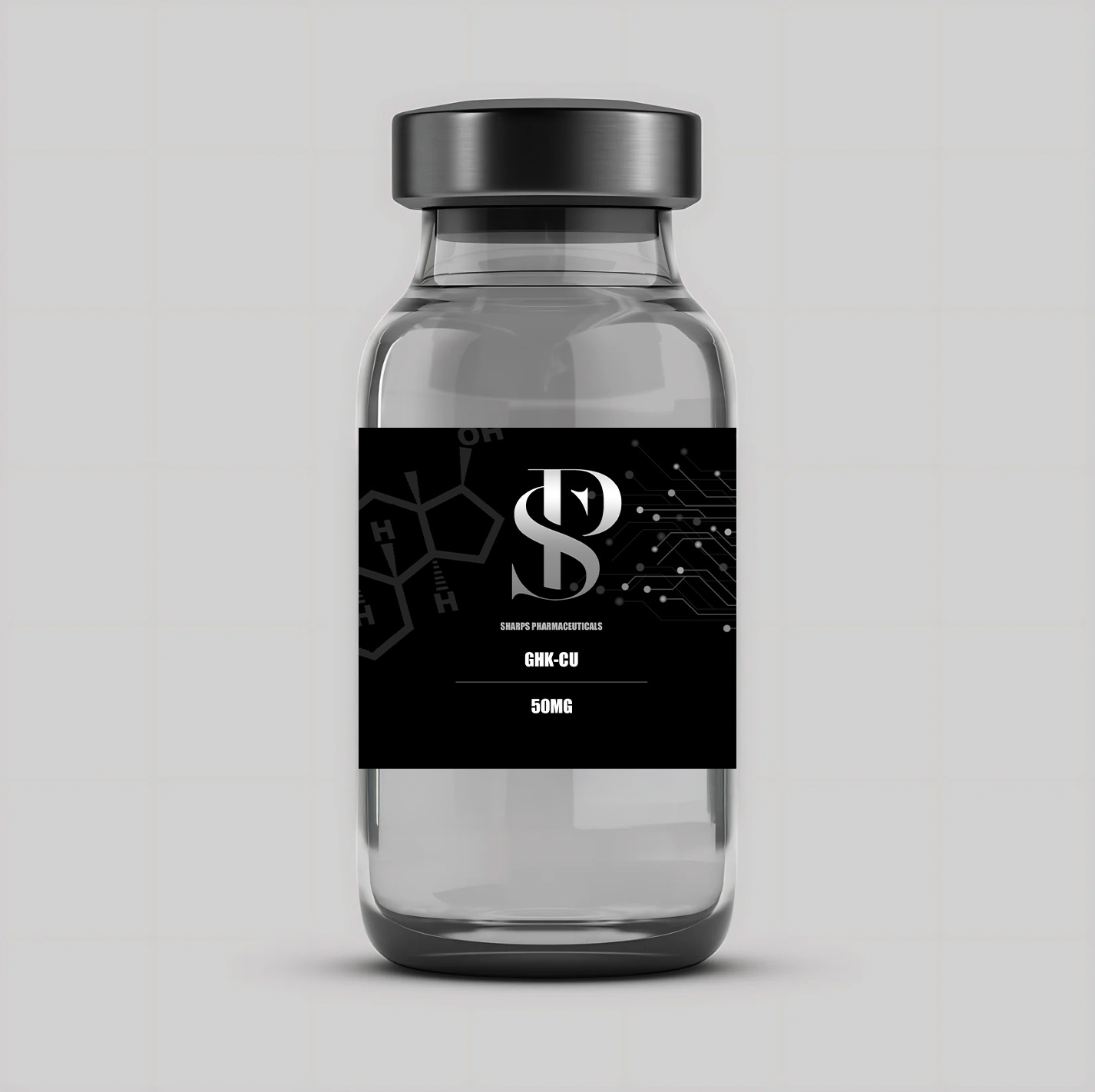
GHK-Cu Research Overview: The Copper Tripeptide in Laboratory Studies
Written from the cited peer-reviewed literature; every product lot is third-party tested.
For research purposes only. This content is intended for educational and informational purposes. Products mentioned are sold strictly for laboratory research use. Not for human consumption. Not for human use. Read more
GHK-Cu is the copper(II) complex of the tripeptide glycyl-L-histidyl-L-lysine. With a research history stretching back to the early 1970s, it is one of the most studied small peptides in laboratory biology.
This overview covers how GHK was discovered, how it binds copper, the main lines of laboratory research, and practical points for researchers working with it.
Discovery
GHK was first isolated from human plasma by Loren Pickart in the early 1970s (Pickart and Thaler, 1973). Pickart was studying factors in plasma that affected the behaviour of liver cells in culture, and identified the tripeptide as one of them. Its strong affinity for copper ions was recognized early, and the copper complex became the most widely studied form.
Copper-binding chemistry
GHK has only three amino acids: glycine, histidine and lysine. It binds copper(II) tightly through the glycine amino group, the histidine imidazole ring and the peptide backbone, forming a stable complex. The complex gives lyophilized GHK-Cu its characteristic blue colour, which carries over into solution.
Because the copper is held by the peptide, anything in an experiment that binds copper strongly, such as chelating agents like EDTA, can strip it from the complex. Researchers should consider this when choosing buffers.
Main lines of research
- Collagen synthesis: early cell-culture work examined the effect of GHK-Cu on collagen production by fibroblasts. Maquart and colleagues reported on this in FEBS Letters in 1988.
- Extracellular matrix: later studies extended to other matrix components and the enzymes that remodel them.
- Gene expression: a 2018 review by Pickart and Margolina (International Journal of Molecular Sciences) summarizes analyses in which GHK was associated with expression changes across a large number of human genes.
- Tissue repair models: GHK-Cu has been examined in animal models of skin and tissue repair since the 1980s.
Much of this literature is preclinical or in vitro, and a substantial part comes from Pickart's own work.
Free GHK versus GHK-Cu
Studies use either the free tripeptide (GHK) or the copper complex (GHK-Cu), and the two behave differently in experiments. When comparing results across papers, check which form was used. In cosmetic ingredient labelling, the copper complex appears under the INCI name copper tripeptide-1.
Handling in the laboratory
GHK-Cu is supplied as a lyophilized powder and is generally reconstituted with bacteriostatic water before use. Copper complexes should be protected from light. Sealed vials are stored at -20°C, protected from light and moisture.
Testing and documentation
Every lot we sell is tested by Freedom Diagnostics, an independent laboratory, using HPLC for purity and mass spectrometry for identity. Certificates are published in our COA library, and each can be verified directly with the lab using the search code printed on it. Our guide explains how to verify a COA.
References
- Pickart L, Thaler MM. Tripeptide in human serum which prolongs survival of normal liver cells and stimulates growth in neoplastic liver. Nature New Biology. 1973. pubmed.ncbi.nlm.nih.gov/4349963/
- Maquart FX, Pickart L, Laurent M, Gillery P, Monboisse JC, Borel JP. Stimulation of collagen synthesis in fibroblast cultures by the tripeptide-copper complex glycyl-L-histidyl-L-lysine-Cu2+. FEBS Letters. 1988. pubmed.ncbi.nlm.nih.gov/3169264/
- Pickart L, Margolina A. Regenerative and protective actions of the GHK-Cu peptide in the light of the new gene data. International Journal of Molecular Sciences. 2018. pubmed.ncbi.nlm.nih.gov/29986520/
Every lot is third-party tested. View the certificate for GHK-Cu →
Related reading
For research purposes only. All products from Canada Research Labs are supplied strictly as reference materials for in-vitro laboratory research by qualified professionals. They are not drugs, natural health products or cosmetics, and have not been authorized by Health Canada for any human or veterinary use.
