Mannitol vs Mannitol-Free Peptides
Written from the cited peer-reviewed literature; every product lot is third-party tested.
For research purposes only. This content is intended for educational and informational purposes. Products mentioned are sold strictly for laboratory research use. Not for human consumption. Not for human use. Read more
What is Mannitol and Why is it Used in Peptide Vials?
Mannitol is a sugar alcohol commonly used as a bulking and lyoprotectant excipient in the lyophilization (freeze-drying) of research peptides. In laboratory preparations, it supports cake formation, protects the peptide during freeze-drying and storage, and contributes to consistent reconstitution characteristics when buffer is introduced to the vial.
Mannitol in Peptide Vials: What You Need to Know
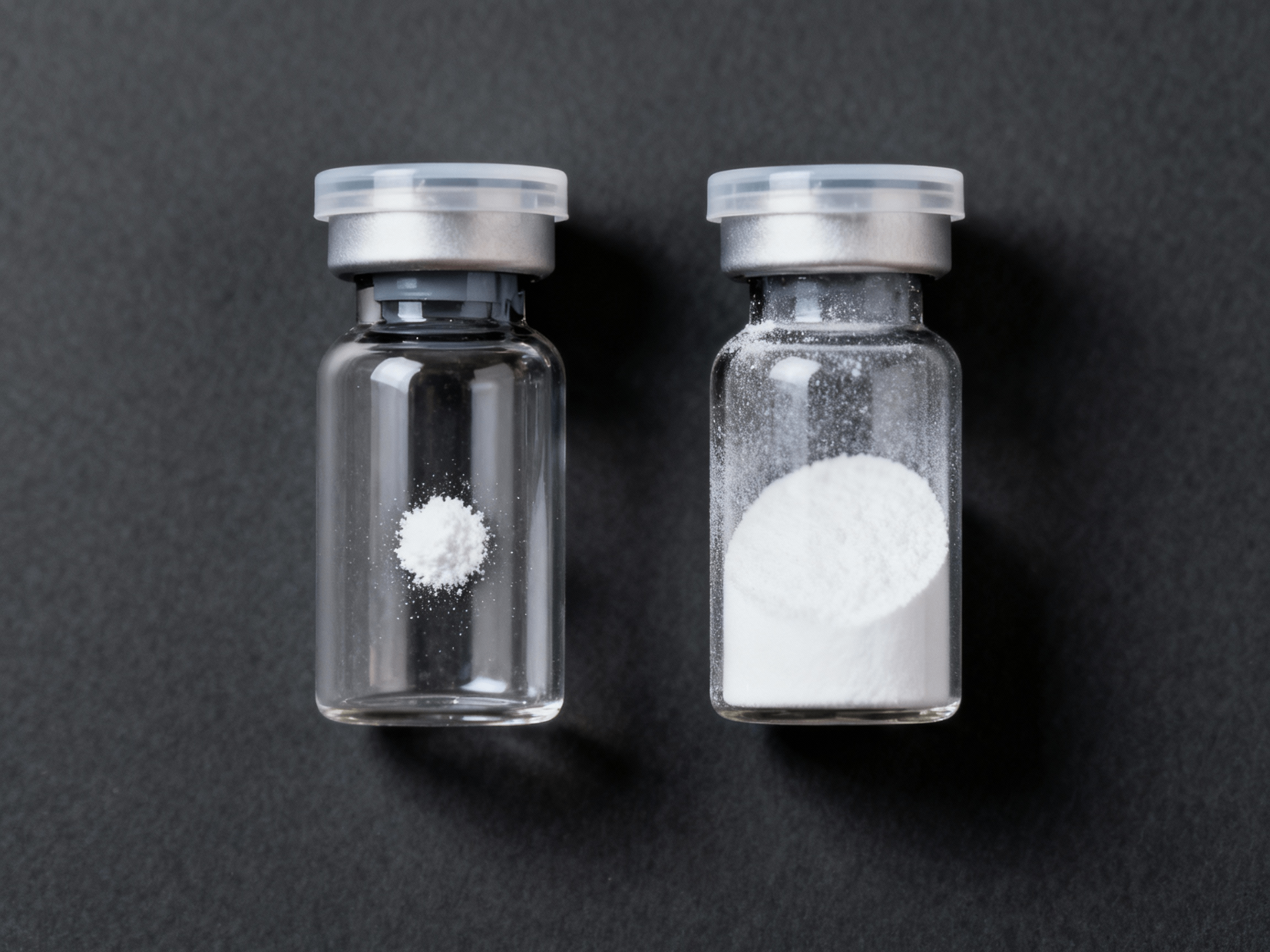
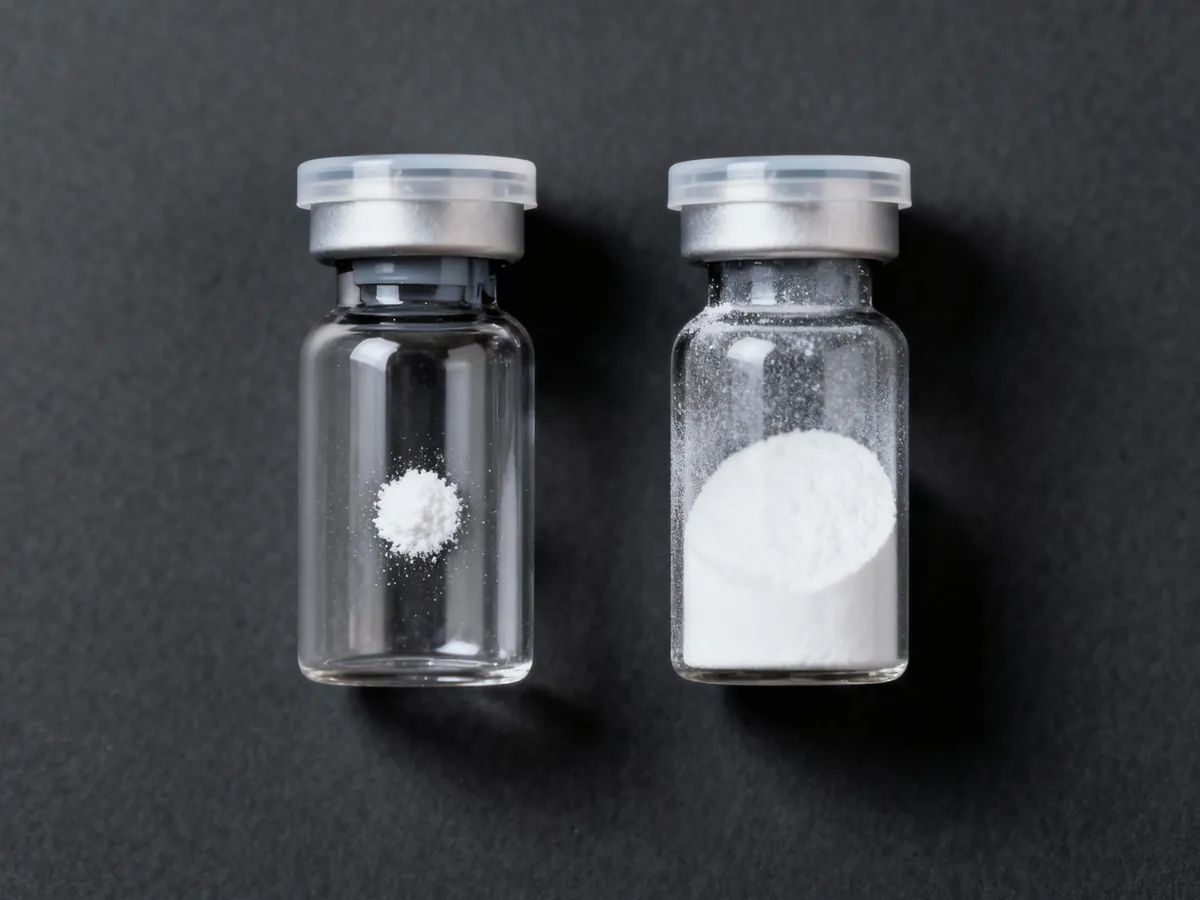
A typical lyophilized research vial contains a small mass of peptide (often 2–10 mg) alongside a larger mass of mannitol (commonly around 250 mg). On a mass basis, mannitol may represent 96–99% of the vial contents, with the remainder being the target peptide. For example, a vial containing 5 mg of peptide and 250 mg of mannitol is approximately 2% peptide by mass, a detail relevant for gravimetric handling, weighing checks, and reconstitution-volume calculations in the laboratory.
Mannitol-Free Peptides: What's the Difference?
Mannitol-free research vials contain only the lyophilized peptide without bulking excipient. Because the total solids are much lower, the visible lyophilized cake or residue is significantly smaller, and a 5 mg fill may appear as a very thin film at the bottom of the vial. This is an expected analytical observation and reflects the absence of bulking excipient rather than any change in peptide content.
Visual Differences Between Peptides
Different research peptides present different lyophilized morphologies. Many peptides form a fine, salt-like residue, while peptides such as TB-500 form a lower-density, snow-like cake. As a result, equivalent masses of different peptides can occupy noticeably different volumes in the vial, a routine physical-characterization observation during laboratory inspection.
Mannitol vs Mannitol-Free: Laboratory Considerations
Mannitol-containing and mannitol-free preparations deliver the same labeled mass of peptide. The choice between formats is an analytical preference driven by laboratory handling and reconstitution characteristics:
- Cake visibility and weighing checks: mannitol provides a visible cake that simplifies visual QC; mannitol-free vials show minimal residue
- Reconstitution behavior: mannitol generally yields a clear, rapidly dissolving solution; mannitol-free vials reconstitute directly into buffer with no excipient contribution to osmolality
- Excipient interference: mannitol-free formats avoid potential interference of bulking excipient in certain in-vitro assays
- Storage and transport robustness: mannitol-containing cakes are typically more mechanically robust during shipping and long-term frozen storage
See the TB-500 and BPC-157 product pages for the vial sizes we supply, and our peptide storage and handling guide for how lyophilized vials are stored before and after reconstitution.
Both formats are intended strictly for in-vitro and preclinical laboratory research and are not for human or veterinary use.
Every lot is third-party tested. View the certificate for BPC-157 (BPC-157 + TB-500 blend) →