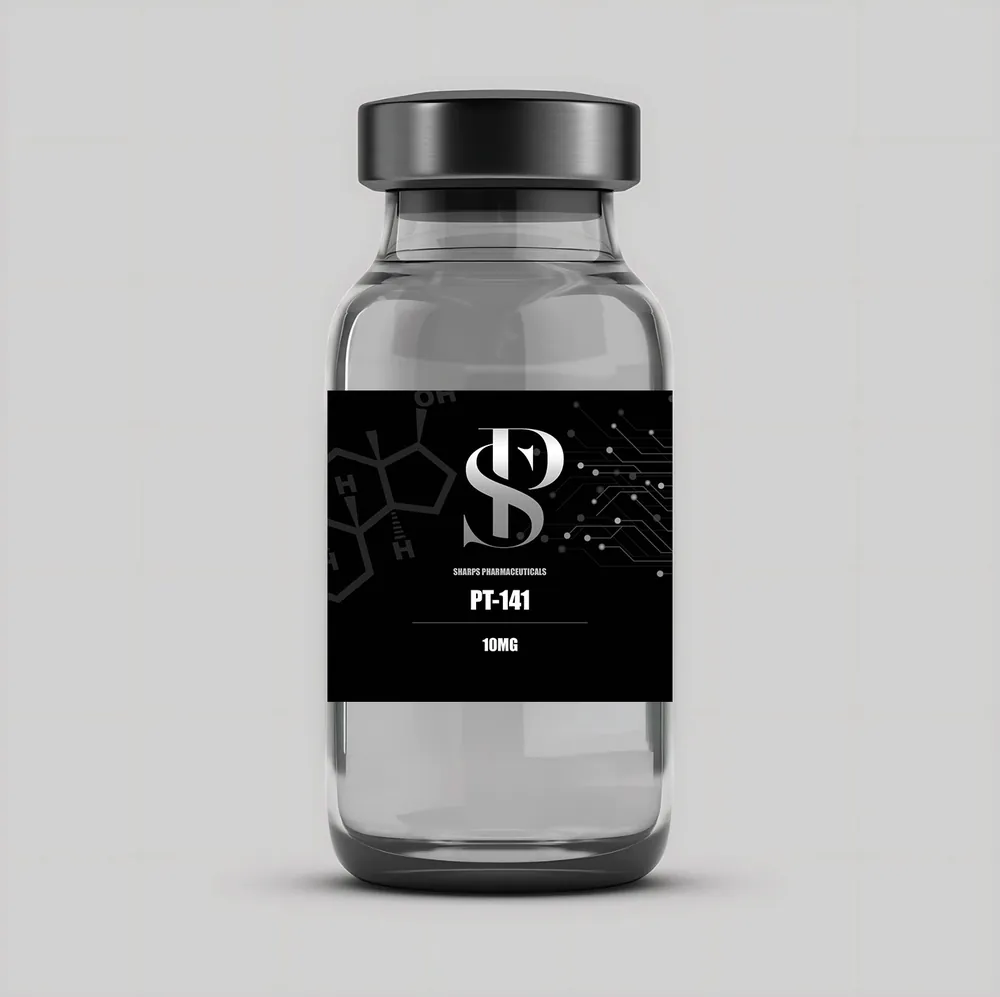
PT-141 (Bremelanotide) Research Overview: Melanocortin Pathways
Written from the cited peer-reviewed literature; every product lot is third-party tested.
For research purposes only. This content is intended for educational and informational purposes. Products mentioned are sold strictly for laboratory research use. Not for human consumption. Not for human use. Read more
PT-141, also known as bremelanotide, is a synthetic cyclic heptapeptide with the structure Ac-Nle-cyclo[Asp-His-D-Phe-Arg-Trp-Lys]-OH. It is a melanocortin receptor agonist studied mainly for its activity at the MC3R and MC4R subtypes, which are expressed in the central nervous system.
This overview covers PT-141's close relationship to Melanotan II, its receptor profile, and a practical point about confirming identity that matters more for this compound than most.
A near-twin of Melanotan II
PT-141 and Melanotan II share the same sequence and the same cyclic ring. The only difference is at the C-terminus: Melanotan II ends in an amide (-NH2), while PT-141 ends in a free carboxylic acid (-OH). PT-141 was identified through research on Melanotan II, and the two are often compared in laboratory studies.
That small change is enough to shift how the molecule interacts with the melanocortin receptors, which makes the pair a useful case study in structure-activity research.
Receptor profile
The melanocortin system has five receptors, MC1R to MC5R. Melanotan II binds MC1R, MC3R, MC4R and MC5R broadly. PT-141 is studied mainly for its activity at MC3R and MC4R, the two subtypes concentrated in the brain, where they are involved in a range of central signaling pathways.
Researchers use PT-141 as a reference compound in preclinical studies of central melanocortin signaling, often alongside Melanotan II to compare the effects of the C-terminal change.
Why identity testing matters for PT-141
Because PT-141 and Melanotan II differ by a single terminal group, their molecular masses are almost identical, about one dalton apart. A vial of one could be mistaken for the other without a precise identity test.
This is why mass spectrometry identity results, and not just HPLC purity, are important when working with these two compounds. A high purity figure confirms the material is clean, but only the measured mass confirms which of the two molecules it is. Check the identity result on the certificate of analysis for the lot you are using.
Laboratory uses
- Studies of MC3R and MC4R signaling in cell and animal models
- Comparative studies with Melanotan II on how C-terminal modifications affect receptor selectivity
- Structure-activity research on cyclic α-MSH analogs
Handling in the laboratory
PT-141 is supplied as a lyophilized powder and is generally reconstituted with bacteriostatic water before use. Sealed vials are stored at -20°C, protected from light and moisture.
Testing and documentation
Every lot we sell is tested by Freedom Diagnostics, an independent laboratory, using HPLC for purity and mass spectrometry for identity. Certificates are published in our COA library, and each can be verified directly with the lab using the search code printed on it. Our guide explains how to verify a COA.
Every lot is third-party tested. View the certificate for PT-141 →
Related reading
For research purposes only. All products from Canada Research Labs are supplied strictly as reference materials for in-vitro laboratory research by qualified professionals. They are not drugs, natural health products or cosmetics, and have not been authorized by Health Canada for any human or veterinary use.