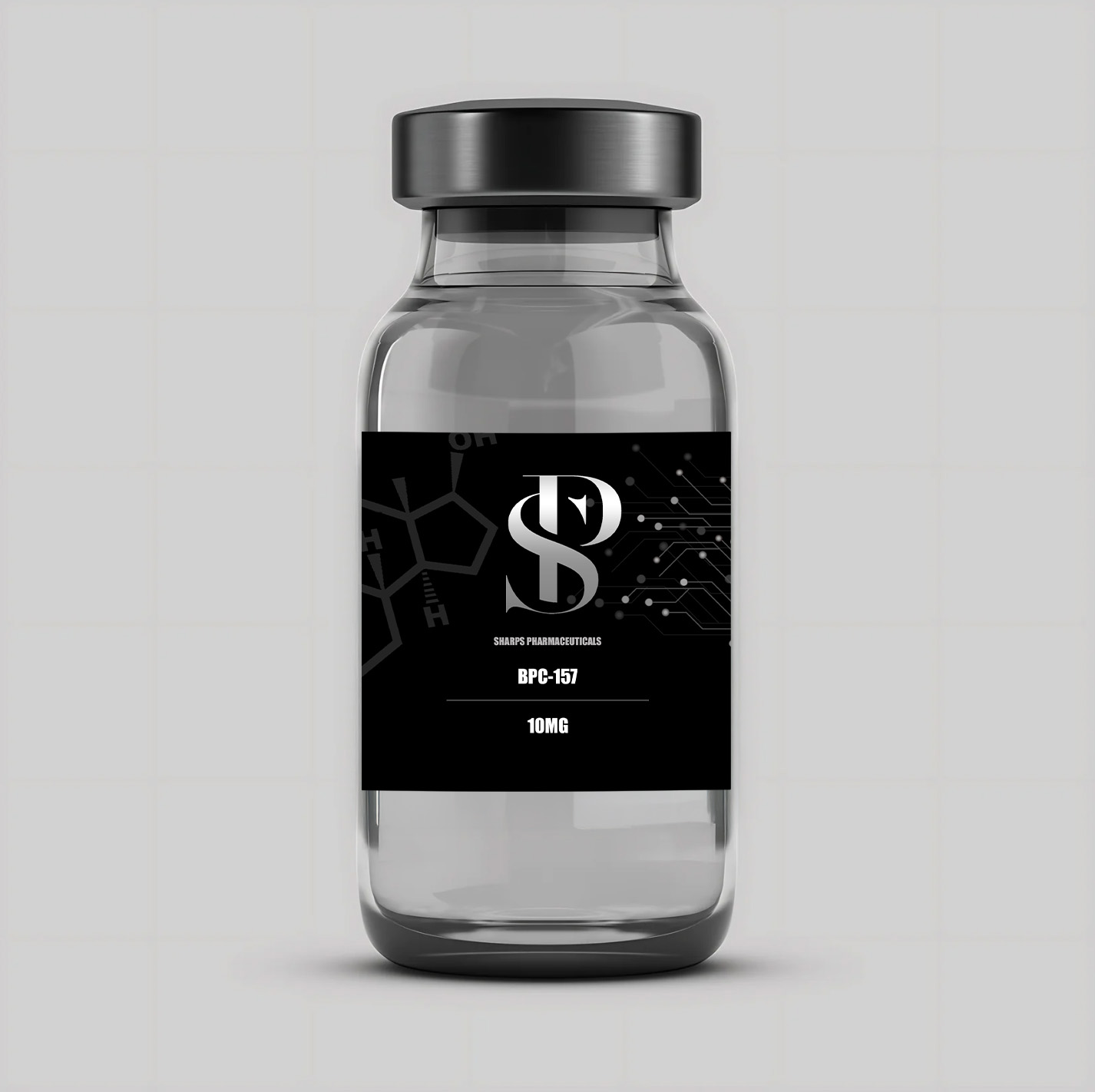
BPC-157 Research Overview: Sequence, Origins and the Preclinical Literature
Written from the cited peer-reviewed literature; every product lot is third-party tested.
For research purposes only. This content is intended for educational and informational purposes. Products mentioned are sold strictly for laboratory research use. Not for human consumption. Not for human use. Read more
BPC-157 is a synthetic pentadecapeptide, a chain of 15 amino acids with the sequence Gly-Glu-Pro-Pro-Pro-Gly-Lys-Pro-Ala-Asp-Asp-Ala-Gly-Leu-Val. Its sequence corresponds to a fragment of a larger protein described in human gastric juice, which gave it the name "Body Protection Compound."
It is one of the most searched research peptides in Canada, and also one of the most debated. This overview covers its origins, the models it has been studied in, and the questions reviewers have raised about the strength of the evidence.
Origins
BPC-157 was developed by a research group at the University of Zagreb in Croatia, led by Predrag Sikirić, beginning in the early 1990s. The group described a protein fraction from gastric juice and later identified the 15-amino-acid sequence now known as BPC-157. In some literature it also appears under the development code PL 14736.
The peptide is often described as stable in gastric juice, unlike many peptides that break down quickly in acidic conditions. That stability is one reason it attracted research interest.
Where the research comes from
A defining feature of the BPC-157 literature is how concentrated it is. A 2025 exchange in the journal Pharmaceuticals (Józwiak et al., 2025) noted that more than 80% of PubMed records on BPC-157 list the Zagreb group as authors. The same reviewers pointed out that basic pharmacokinetic and pharmacodynamic characterization is still limited.
Researchers should keep this in mind. A large body of papers from one group is not the same as independent replication across many labs.
Models it has been studied in
Published work on BPC-157 is overwhelmingly preclinical. The main areas include:
- Nitric oxide signaling: interactions with the nitric oxide system in vascular and tissue models, a recurring theme in the Zagreb group's work.
- Angiogenesis-related gene expression: studies of VEGF and VEGFR2 signaling in endothelial cell models.
- Tendon fibroblasts: Chang and colleagues examined tendon fibroblast outgrowth and migration (Chang et al., 2011, Journal of Applied Physiology) and growth hormone receptor expression in tendon fibroblasts (Chang et al., 2014, Molecules).
- Gastrointestinal models: studies of mucosal integrity in rodent models, reflecting the peptide's gastric origin.
Results in rodent and cell-culture models do not establish activity in other systems.
Open questions in the literature
Critical commentary has grown alongside public interest. Besides the 2025 Pharmaceuticals exchange, McGill University's Office for Science and Society has published a commentary on the gap between the preclinical literature and popular claims made about BPC-157.
BPC-157 is also named on the World Anti-Doping Agency's Prohibited List under non-approved substances. It is not authorized by Health Canada for any human or veterinary use.
Handling in the laboratory
BPC-157 is supplied as a lyophilized powder and is generally reconstituted with bacteriostatic water before use. Sealed vials are stored at -20°C, protected from light and moisture.
Testing and documentation
Every lot we sell is tested by Freedom Diagnostics, an independent laboratory, using HPLC for purity and mass spectrometry for identity. Certificates are published in our COA library, and each can be verified directly with the lab using the search code printed on it. Our guide explains how to verify a COA.
References
- Józwiak M, Bauer M, Kamysz W, Kleczkowska P. Reply to Sikiric et al. Comment on "Józwiak et al. Multifunctionality and Possible Medical Application of the BPC 157 Peptide: Literature and Patent Review". Pharmaceuticals (Basel). 2025. pubmed.ncbi.nlm.nih.gov/41155566/
- Chang CH, Tsai WC, Lin MS, Hsu YH, Pang JH. The promoting effect of pentadecapeptide BPC 157 on tendon healing involves tendon outgrowth, cell survival, and cell migration. Journal of Applied Physiology. 2011. pubmed.ncbi.nlm.nih.gov/21030672/
- Chang CH, Tsai WC, Hsu YH, Pang JH. Pentadecapeptide BPC 157 enhances the growth hormone receptor expression in tendon fibroblasts. Molecules. 2014. pubmed.ncbi.nlm.nih.gov/25415472/
Every lot is third-party tested. View the certificate for BPC-157 (BPC-157 + TB-500 blend) →
Related reading
For research purposes only. All products from Canada Research Labs are supplied strictly as reference materials for in-vitro laboratory research by qualified professionals. They are not drugs, natural health products or cosmetics, and have not been authorized by Health Canada for any human or veterinary use.

