TB-500 Research Overview: Thymosin β4, Actin Binding and Cell Migration
Written from the cited peer-reviewed literature; every product lot is third-party tested.
For research purposes only. This content is intended for educational and informational purposes. Products mentioned are sold strictly for laboratory research use. Not for human consumption. Not for human use. Read more
TB-500 is the commercial name for synthetic thymosin β4 (Tβ4), a 43-amino-acid peptide found in nearly every mammalian cell. Thymosin β4 is best known as one of the main proteins that bind monomeric actin, and it has been studied for more than four decades in research on the cytoskeleton and cell migration.
This overview covers what thymosin β4 is, how it interacts with actin, the preclinical research most often cited, and why researchers need to check exactly which molecule they are working with when they buy something labelled "TB-500".
What thymosin β4 is
Thymosin β4 was first isolated from preparations of calf thymus tissue, which is where the "thymosin" name comes from. Its complete amino acid sequence was reported in 1981 by Low, Hu and Goldstein in the Proceedings of the National Academy of Sciences. Later work showed that thymosin β4 is not specific to the thymus: it is present in most cell types and is especially abundant in platelets and white blood cells.
The peptide has 43 amino acids and an acetylated N-terminus. Its first four residues, Ac-Ser-Asp-Lys-Pro (Ac-SDKP), can be released as a separate tetrapeptide, which has its own research literature.
Actin binding and the WH2 motif
Actin exists in cells as monomers (G-actin) and filaments (F-actin), and the balance between them controls cell shape and movement. In the early 1990s, Safer and colleagues (1991) established thymosin β4 as a major actin-sequestering peptide: it binds actin monomers and holds them in reserve, keeping them from joining filaments until they are needed.
Most of this binding depends on a short sequence around residues 17–23, LKKTETQ, known as a WH2 (WASP-homology 2) motif. This is why some suppliers sell a short fragment containing this region under the TB-500 name, while others sell the full 43-amino-acid peptide.
Preclinical research most often cited
- Cell migration: because it regulates the pool of available actin, thymosin β4 is widely used in cell-culture studies of how cells move and change shape.
- Cardiac models: Bock-Marquette and colleagues (Nature, 2004) reported that thymosin β4 activates integrin-linked kinase and influences cardiomyocyte migration and survival in mouse models. It is one of the most frequently cited thymosin β4 papers.
- Angiogenesis: several groups have examined thymosin β4 in laboratory models of blood vessel formation, including endothelial cell migration and tube-formation assays.
- Tissue repair models: thymosin β4 has been studied in animal models of skin, corneal and other tissue repair, building on its role in cell migration.
Almost all of this work is preclinical, using cell culture or animal models. Results in one model do not establish activity in another.
Why "TB-500" varies between suppliers
"TB-500" is not a standardized scientific name. Depending on the supplier, it can mean:
- Full-length synthetic thymosin β4 (43 amino acids)
- A short fragment such as the 17–23 region (Ac-LKKTETQ), sometimes sold as "TB-500 Frag 17-23"
- Other partial sequences
These are different molecules with very different molecular weights, so results from one cannot be assumed to apply to another. Before comparing your results with published studies, check the sequence and molecular mass on the certificate of analysis. The mass spectrometry identity result makes the difference easy to spot.
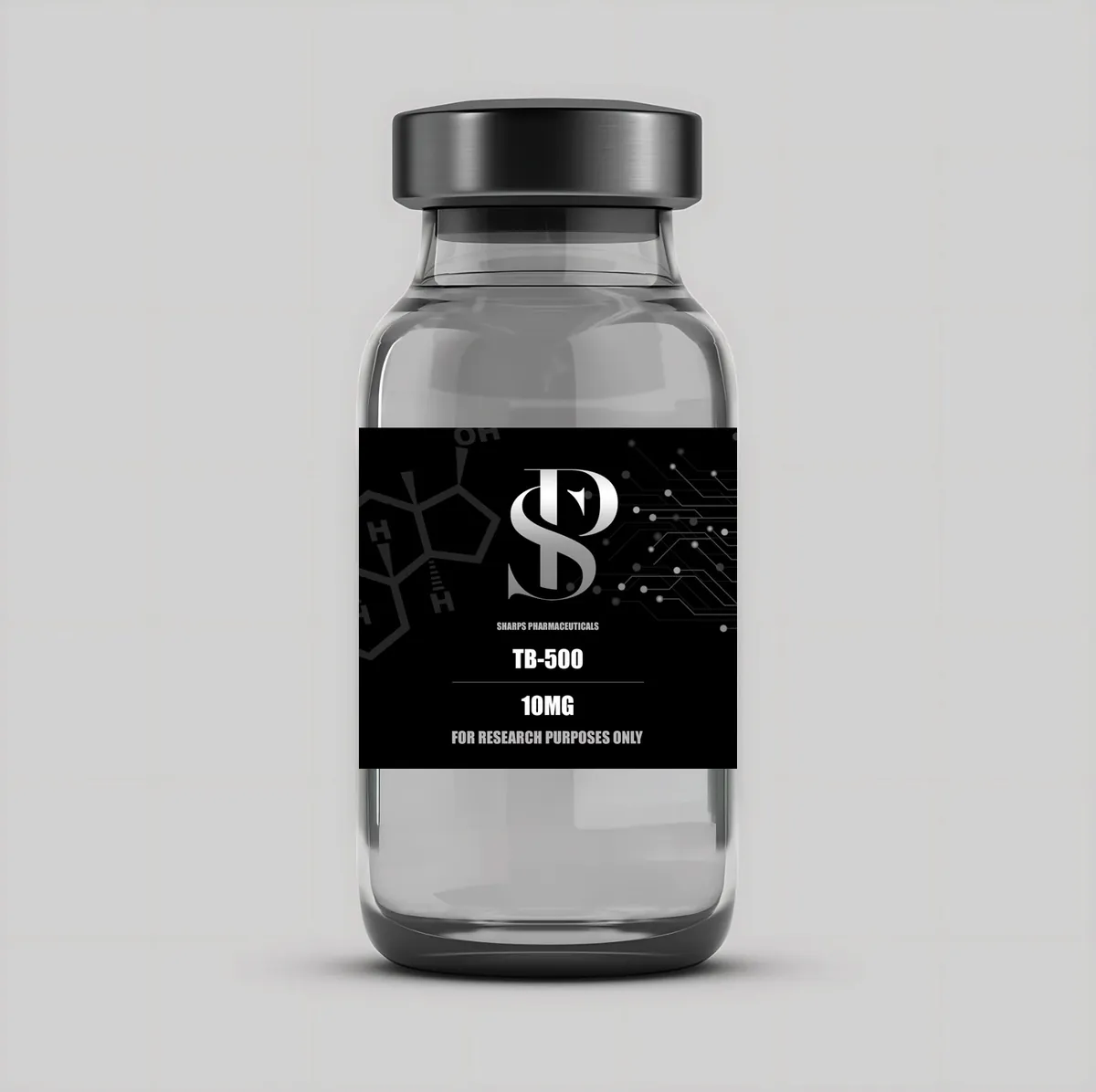
Our TB-500 is full-length synthetic thymosin β4, supplied as 10mg of lyophilized powder.
Handling in the laboratory
Thymosin β4 is supplied as a lyophilized powder because peptides are far more stable dry. It is generally reconstituted with bacteriostatic water before use. Sealed vials are stored at -20°C, protected from light and moisture.
Testing and documentation
Every lot we sell is tested by Freedom Diagnostics, an independent laboratory, using HPLC for purity and mass spectrometry for identity. Certificates are published in our COA library, and each can be verified directly with the lab using the search code printed on it. Our guide explains how to verify a COA.
References
- Low TL, Hu SK, Goldstein AL. Complete amino acid sequence of bovine thymosin beta 4: a thymic hormone that induces terminal deoxynucleotidyl transferase activity in thymocyte populations. Proceedings of the National Academy of Sciences of the USA. 1981. pubmed.ncbi.nlm.nih.gov/6940133/
- Safer D, Elzinga M, Nachmias VT. Thymosin beta 4 and Fx, an actin-sequestering peptide, are indistinguishable. Journal of Biological Chemistry. 1991. pubmed.ncbi.nlm.nih.gov/1999398/
- Bock-Marquette I, Saxena A, White MD, DiMaio JM, Srivastava D. Thymosin beta4 activates integrin-linked kinase and promotes cardiac cell migration, survival and cardiac repair. Nature. 2004. pubmed.ncbi.nlm.nih.gov/15565145/
Every lot is third-party tested. View the certificate for TB-500 10mg (BPC-157 + TB-500 blend) →
Related reading
For research purposes only. All products from Canada Research Labs are supplied strictly as reference materials for in-vitro laboratory research by qualified professionals. They are not drugs, natural health products or cosmetics, and have not been authorized by Health Canada for any human or veterinary use.