Net Peptide Content vs Purity: Why a Vial Isn't 100% Peptide
Written from the cited peer-reviewed literature; every product lot is third-party tested.
For research purposes only. This content is intended for educational and informational purposes. Products mentioned are sold strictly for laboratory research use. Not for human consumption. Not for human use. Read more
"99% pure" is often read as "99% peptide". It isn't. Purity and net peptide content are two different measurements, and confusing them is one of the most common mistakes in reading a certificate of analysis.
Purity
Purity is measured by HPLC. It tells you what share of the peptide-related material in the sample is the target peptide, as opposed to closely related impurities such as deletion sequences or truncated chains.
It does not account for anything the HPLC detector doesn't see, such as water and salts. A sample can be 99% pure and still contain a substantial amount of non-peptide material.
Net peptide content
Net peptide content is the share of the powder's total weight that is actually peptide. The rest is made up of:
- Counter-ions: peptides are supplied as salts, paired with ions such as acetate or trifluoroacetate (TFA) that carry the opposite charge. These add weight.
- Water: lyophilized peptides are often hygroscopic and retain or absorb some moisture.
- Excipients: some products include bulking agents such as mannitol, added during freeze-drying.
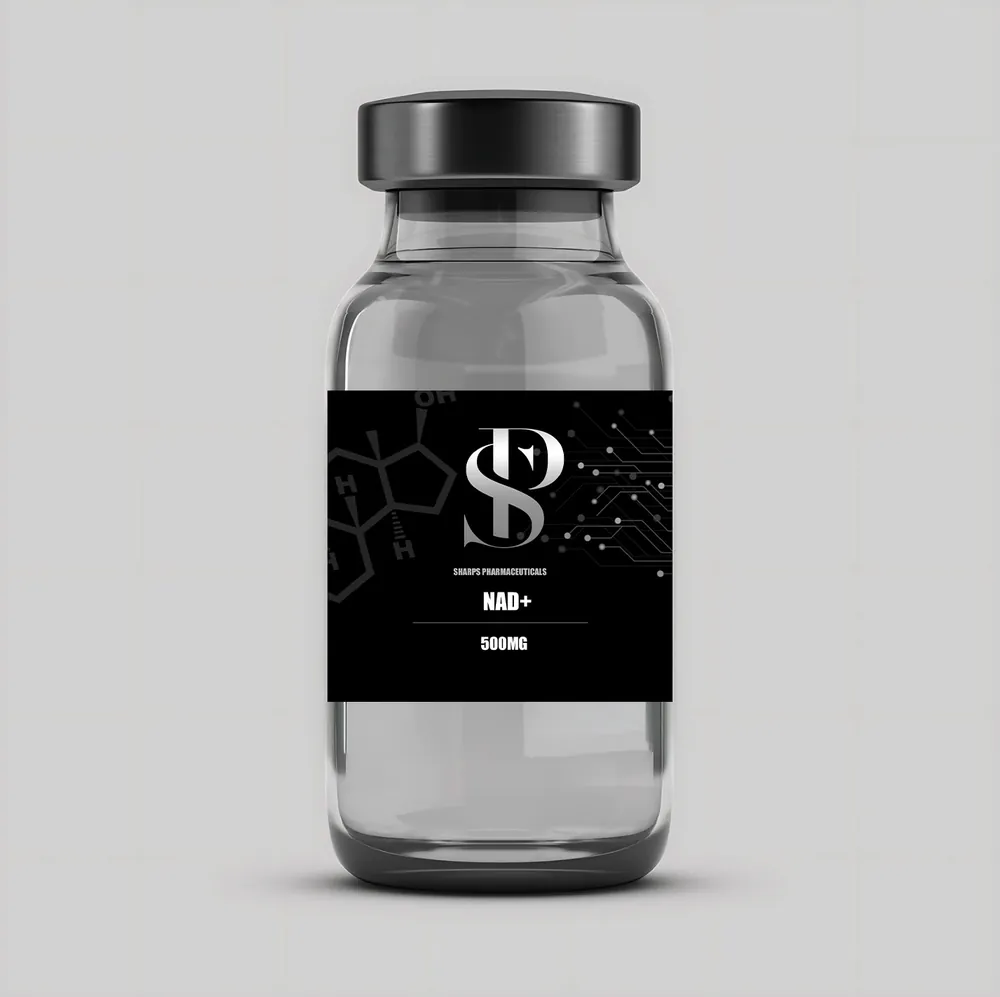
Net peptide content is measured by different methods from purity, typically amino acid analysis or elemental nitrogen analysis. It is commonly well below 100%, even for highly pure peptides. Some certificates report it as a separate result: the certificates for our NAD+ (certificate) and GHK-Cu (certificate) list net peptide content alongside purity and identity. All of our published certificates are in the COA library.
An example
Imagine a vial of powder that is 99% pure by HPLC with a net peptide content of 80%. Of the total powder weight, about 80% is peptide, and of that peptide material, 99% is the target sequence. The remaining 20% of the weight is counter-ions, water and any excipients.
These figures are only an illustration. The actual numbers vary between peptides, salt forms and production lots.
Why it matters in the lab
- Concentration calculations: if a calculation assumes the full powder weight is peptide, the actual concentration of peptide in a solution will be lower than calculated.
- Comparing suppliers: two products with the same stated amount and the same purity can contain different amounts of actual peptide, depending on how the amount is defined.
- Reading the label: ask whether a stated amount refers to the total powder or the net peptide, and check whether the certificate reports net peptide content.
What to look for on a certificate
- Purity by HPLC, as a percentage
- Identity by mass spectrometry, as a measured mass compared with the expected mass
- Net peptide content or quantity, if the laboratory reports it
- A lot number that matches your vial
Testing and documentation
Every lot we sell is tested by Freedom Diagnostics, an independent laboratory, using HPLC for purity and mass spectrometry for identity. Certificates are published in our COA library, and each can be verified directly with the lab. Our guides explain how HPLC and mass spectrometry work and how to verify a COA.
For research purposes only. All products from Canada Research Labs are supplied strictly as reference materials for in-vitro laboratory research by qualified professionals. They are not drugs, natural health products or cosmetics, and have not been authorized by Health Canada for any human or veterinary use.
Every lot is third-party tested. View the certificate for NAD+ →