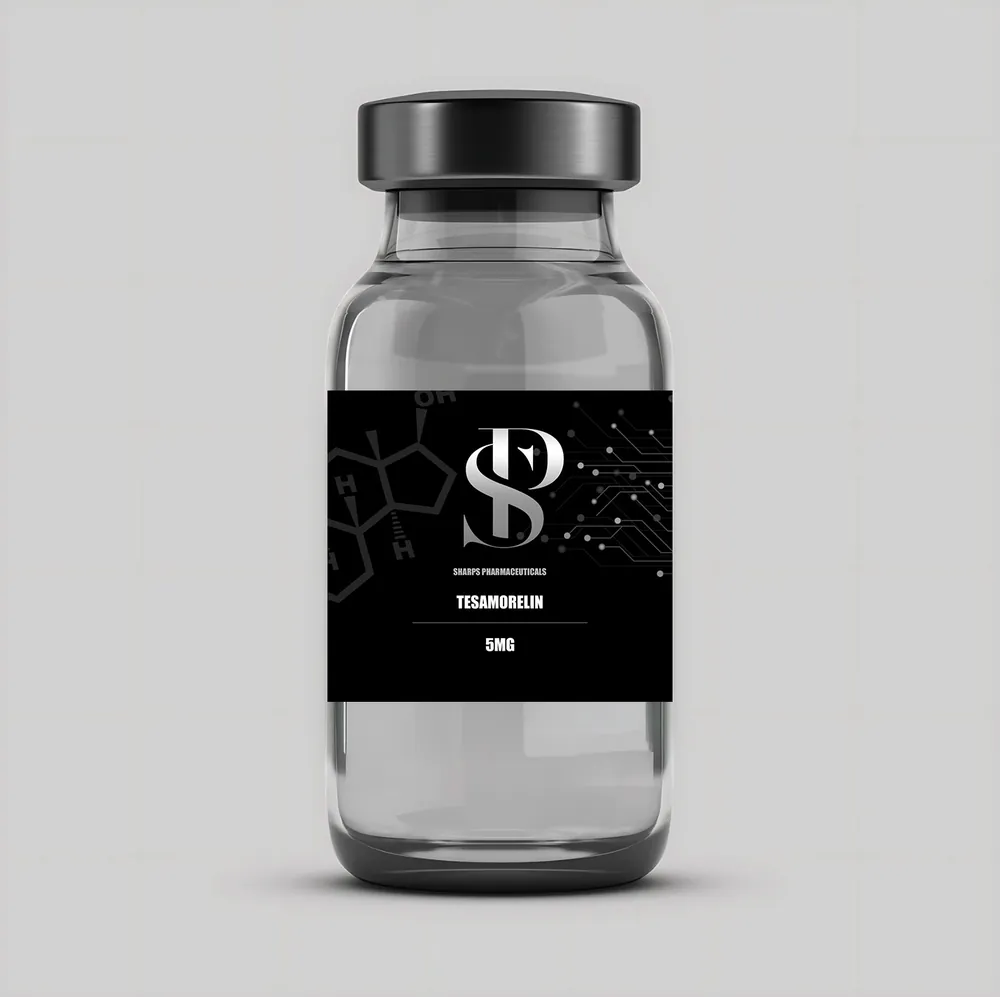
Tesamorelin Research Overview: A Stabilized Full-Length GHRH Analog
Written from the cited peer-reviewed literature; every product lot is third-party tested.
For research purposes only. This content is intended for educational and informational purposes. Products mentioned are sold strictly for laboratory research use. Not for human consumption. Not for human use. Read more
Tesamorelin is a synthetic analog of growth hormone-releasing hormone (GHRH) that keeps all 44 amino acids of the natural hormone and adds one chemical modification at its start. That combination makes it a full-length GHRH analog that resists the enzyme which rapidly breaks down the natural hormone.
The discovery of GHRH
Growth hormone-releasing hormone was isolated and sequenced in 1982 by independent research groups (Guillemin et al., 1982; Rivier et al., 1982). The hormone was first purified from pancreatic tumours that were producing it in excess, because the amounts made by the hypothalamus were too small to work with.
Human GHRH is a 44-amino-acid peptide. Researchers soon found that its first 29 amino acids, GHRH(1-29), retain full activity at the GHRH receptor, which led to shorter analogs such as Sermorelin.
Why native GHRH breaks down so quickly
Native GHRH has a short working life in biological systems. A major reason is the enzyme dipeptidyl peptidase-4 (DPP-4), which cuts the first two amino acids (tyrosine and alanine) off the N-terminus. The shortened peptide is far less active at the GHRH receptor.
How Tesamorelin is modified
Tesamorelin carries a trans-3-hexenoyl group attached to its N-terminal tyrosine. This addition protects the vulnerable start of the chain from DPP-4, while the rest of the 44-amino-acid sequence remains the same as natural GHRH.
How it compares with other GHRH analogs
- Sermorelin: GHRH(1-29) with no stabilizing changes. Shortest active sequence, but breaks down quickly.
- CJC-1295 without DAC (Mod GRF 1-29): GHRH(1-29) with four amino-acid substitutions for stability.
- Tesamorelin: the full 44 amino acids, with the N-terminal modification.
Our article comparing GHRH analogs covers these differences in more detail.
Research uses
Tesamorelin is used in laboratory research on GHRH receptor pharmacology, particularly where researchers want a stable analog that keeps the complete natural sequence instead of a shortened one.
Handling in the laboratory
Tesamorelin is supplied as a lyophilized powder and is generally reconstituted with bacteriostatic water before use. Sealed vials are stored at -20°C, protected from light and moisture.
Testing and documentation
Every lot we sell is tested by Freedom Diagnostics, an independent laboratory, using HPLC for purity and mass spectrometry for identity. Our current Tesamorelin lot tested at 96.946% purity by HPLC. We publish results as tested, and the certificate is in our COA library, where it can be verified directly with the lab.
For research purposes only. All products from Canada Research Labs are supplied strictly as reference materials for in-vitro laboratory research by qualified professionals. They are not drugs, natural health products or cosmetics, and have not been authorized by Health Canada for any human or veterinary use.
References
- Guillemin R, Brazeau P, Böhlen P, Esch F, Ling N, Wehrenberg WB. Growth hormone-releasing factor from a human pancreatic tumor that caused acromegaly. Science. 1982. pubmed.ncbi.nlm.nih.gov/6812220/
- Rivier J, Spiess J, Thorner M, Vale W. Characterization of a growth hormone-releasing factor from a human pancreatic islet tumour. Nature. 1982. pubmed.ncbi.nlm.nih.gov/6292724/
Every lot is third-party tested. View the certificate for Tesamorelin →